Thirty-two years after the FIFA World Cup last touched down on American soil, the United States Men’s National Team (USMNT) delivered a homecoming performance that will echo in the history books. In front of a raucous, 70,492-strong crowd at the Los Angeles Stadium, Mauricio Pochettino’s side dismantled Paraguay 4-1, launching their 2026 World Cup campaign with a ruthless display of attacking football.
Driven by a spectacular first-half brace from Folarin Balogun and a masterful playmaking performance from Christian Pulisic, the United States overwhelmed a youthful Paraguayan side. The victory not only secures three vital points in Group D but also serves as a resounding declaration that this USMNT squad is built to entertain, dominate, and contend on the global stage.
The First-Half Blitz: Speed, Skill, and Suffocation
The match commenced with an undeniable electrical charge, and Pochettino’s tactical blueprint was immediately apparent. The United States set up in an aggressive 4-2-3-1 formation, relentlessly pressing high up the pitch and starving Gustavo Alfaro’s side of any time to settle.
The pressure paid dividends almost instantly. Just seven minutes into the contest, the USMNT sliced through the Paraguayan defensive lines. Weston McKennie initiated the move, surging past Miguel Almirón and filtering the ball out wide to Pulisic. The AC Milan winger danced gracefully between two defenders, drawing a third before slipping a clever pass back to McKennie, who had continued his run. McKennie’s resulting cutback caused sheer panic in the six-yard box, forcing Paraguayan midfielder Damián Bobadilla to inadvertently bundle the ball into his own net.
Clocking in at just under seven minutes, the opening strike became the third-fastest goal scored by a host nation in their first match of a World Cup, trailing only France in 1938 (35 seconds) and Germany in 2006 (five minutes).
Paraguay, fielding their youngest World Cup starting XI since 1998 with an average age of just over 26, looked visibly rattled. They struggled to mount any cohesive response, completing very few passes in the final third as the American midfield pivot of Tyler Adams and Malik Tillman dictated the tempo.
The Balogun Show
As the half progressed, Folarin Balogun cemented his status as the focal point of the American attack. In the 28th minute, the striker thought he had doubled the lead after finishing a slick sequence involving McKennie and Pulisic, only for his celebrations to be cut short by an offside flag against the American captain.
Balogun’s frustration, however, was fleeting. Less than three minutes later, Pulisic carved open the Paraguayan defence once more. Drifting off the left flank, Pulisic delivered an inviting, perfectly weighted pass toward the penalty spot. This time, Balogun timed his run to perfection, holding his nerve to side-foot a pristine finish past the diving Orlando Gill, making it 2-0.
The United States were not done. Deep into first-half stoppage time (45+5′), they delivered a crushing psychological blow. Malik Tillman, who was exceptional all evening, picked up the ball near the centre circle. Spotting Balogun’s darting run, Tillman threaded a phenomenal, defence-splitting pass. Balogun latched onto it, shrugged off a desperate sliding challenge from Omar Alderete, and emphatically roofed his shot into the top-left corner.
The halftime whistle blew with the scoreboard reading 3-0. It marked the first time in history that the United States had ever held a three-goal advantage at the interval of a World Cup match.
Tactical Shifts and Paraguay’s Consolation
With a comfortable lead secured, Pochettino opted to manage his squad’s workload, removing the brilliant Christian Pulisic at halftime. Pulisic finished his 45-minute shift having completed a match-high three dribbles and creating two major chances, cementing his role as the irreplaceable heartbeat of the American offense. Sebastian Berhalter was introduced in his place, signalling a slight shift toward game management.
The second half adopted a notably slower rhythm. The United States enjoyed long, unhurried spells of possession, while Paraguay, forced to chase the game, finally began to push their defensive line higher. The introduction of fresh legs by Alfaro eventually yielded a moment of respite for the South Americans.
In the 73rd minute, a long free-kick from goalkeeper Orlando Gill bypassed the American midfield, eventually falling to Miguel Almirón. The Newcastle United man nudged the ball into the path of Julio Enciso, who showed excellent situational awareness. Rather than forcing a shot, Enciso slid an unselfish pass to his left for substitute Mauricio. The midfielder, who had been introduced at halftime, struck a confident first-time finish past Matt Freese, cutting the deficit to 3-1 and briefly reigniting a flicker of hope for La Albirroja.
The Final Flourish: Reyna’s Trivela
Any thoughts of a miraculous Paraguayan comeback were meticulously managed by a veteran American backline, marshalled by Tim Ream. The Fulham defender, making history as the oldest player to ever feature for the USMNT at a World Cup (38 years and 250 days), was an absolute rock, extinguishing fires and building out from the back with composed authority.
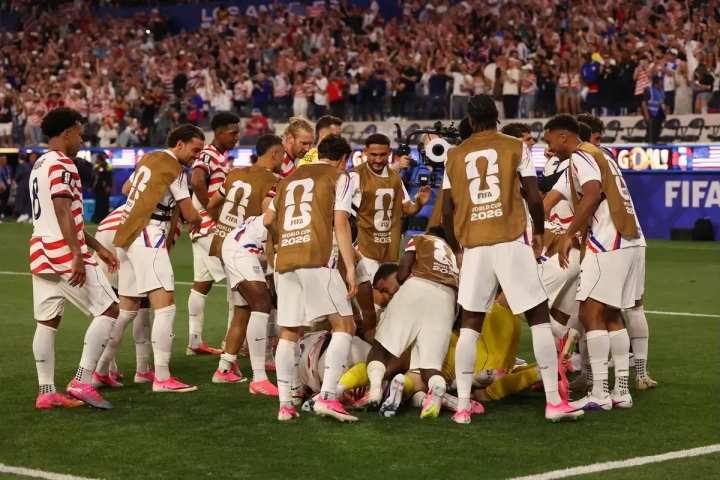
As the match bled into eight minutes of stoppage time, the United States provided one final moment of magic. Substitute Giovanni Reyna, eager to leave his mark on the tournament, found himself on the receiving end of a clever sequence down the right flank. Alex Freeman, who had enjoyed a stellar game at right-back, interchanged passes with Timothy Weah before sliding the ball to Reyna. Unmarked inside the 18-yard box, Reyna casually struck a gorgeous trivela (outside-of-the-boot) shot that curled elegantly past Gill and tucked itself inside the far post.
The 98th-minute strike cemented a 4-1 victory, sending the Southern California crowd into a state of sheer euphoria.
By The Numbers: A Statistical Imbalance
The final statistics paint the picture of a match heavily skewed in favour of the co-hosts. The USMNT controlled the ball, the territory, and the high-danger areas from start to finish.
Metric | United States | Paraguay |
Ball Possession | 65% | 35% |
Expected Goals (xG) | 1.42 | 0.54 |
Total Shots | 16 | 9 |
Touches in Opposition Box | 53 | 11 |
Corners | 7 | 2 |
Historical Context & Milestones
The victory over Paraguay carried a heavy sense of historical symmetry. The only other time the United States and Paraguay met at a FIFA World Cup was during the inaugural tournament in 1930. The United States won that match 3-0, fuelled by the first-ever hat-trick in World Cup history, courtesy of Bert Patenaude.
Nearly a century later, Folarin Balogun channelled Patenaude’s spirit, becoming only the second American player in history to score multiple goals in a single World Cup fixture.
Furthermore, Pochettino’s starting XI highlighted the current depth and global pedigree of American soccer. For the first time in history, the USMNT fielded a World Cup lineup featuring at least one player currently employed in each of Europe’s traditional “Big Five” leagues (Premier League, La Liga, Serie A, Bundesliga, and Ligue 1).
Looking Ahead: The Road Through Group D
For Mauricio Pochettino and his squad, this 4-1 thrashing serves as the perfect foundation. They successfully navigated the immense pressure of opening a home World Cup, blending defensive solidity with an attacking flair that overwhelmed their South American opponents.
The United States will now travel up the West Coast to Seattle, where they face Australia on Friday, June 19. A victory against the Socceroos would almost certainly guarantee their progression to the knockout stages, further validating the high expectations placed upon this “Golden Generation.”
For Gustavo Alfaro and Paraguay, the post-mortem will be difficult. La Albirroja looked shell-shocked by the occasion and the speed of the American transitions. They must quickly regroup and find their defensive identity before their crucial clash against Türkiye in San Francisco next Saturday, a match that will ultimately decide their tournament survival.
If this opening night in Los Angeles is any indication, the 2026 FIFA World Cup on American soil promises to be a thrilling, high-scoring spectacle, and the United States Men’s National Team intends to be the main attraction.