On a crisp Tuesday evening at Trent Bridge in Nottingham, the host nation delivered a brutal statement of intent, entirely dismantling their visitors by a staggering 125-run margin in the third T20 International. Commencing at 17:30 BST on 7 July 2026, the capacity crowd was treated to a masterclass in both explosive batting and hostile fast bowling. This emphatic victory secures an unassailable 2-0 series lead for the home side with just two matches remaining, ensuring they cannot lose the five-match contest following the rain-abandoned opener in Durham.
Proceedings began with the touring captain, Shreyas Iyer, successfully calling the toss and electing to bowl first. Anticipating early swing and hoping to exploit any lingering moisture under the floodlights, the decision was a calculated gamble designed to put the aggressive home openers under immediate pressure. Unfortunately for the fielding side, that theoretical pressure never materialised against a top order in punishing form.
The Foundation Built on Aggression
Phil Salt and Jos Buttler strode to the crease with characteristic intent, instantly seizing the initiative. Buttler was in a particularly destructive mood during the powerplay, dispatching the new ball with disdain. The experienced wicketkeeper-batter raced to 36 from just 21 deliveries, an entertaining cameo laced with four boundaries and two colossal sixes. His aggression perfectly complemented Salt, who initially anchored the partnership before launching his own calculated assault.
When Buttler eventually departed, Salt seamlessly assumed the role of the primary aggressor. The dynamic opener compiled a magnificent 70 off 44 balls, operating at a strike rate of 159.09. He hammered seven boundaries and cleared the ropes on three separate occasions, showcasing remarkable versatility against both pace and spin. Salt’s innings formed the absolute bedrock of the massive total, completely nullifying the visitors’ attempts to establish any control during the middle overs.
Middle-Order Wobble and a Late Surge
Despite the imposing platform, the batting side briefly stumbled, offering a glimmer of hope to the fielding unit. The middle order experienced a sudden, unexpected wobble against the disciplined variations of the touring seamers. Tom Banton suffered a miserable outing, dismissed for a golden duck after slicing a delivery straight to short third man. Jacob Bethell, the hero of the previous encounter in Manchester, briefly threatened with 13 off nine balls before miscuing a slog sweep to deep mid-wicket.
During this frantic period, Prince Yadav and Harshit Rana briefly hauled their side back into the contest. Both seamers bowled with commendable heart on a flat surface, finishing with identical wicket tallies of two apiece. Yadav conceded 30 runs from his four overs, while Rana leaked 40, but their timely breakthroughs threatened to restrict the total below the psychological 200-run barrier. Axar Patel also chipped in, eventually removing the dangerous Salt, who edged a sharp delivery straight to backward point in the 18th over.
Sensing the momentum shifting, Sam Curran arrived at the crease and immediately launched a fierce counter-attack. The all-rounder was utterly ruthless, bludgeoning 41 from a mere 24 deliveries. Relying on sheer timing and intelligent placement, Curran struck four crucial boundaries to accelerate the run rate through the death overs. A chaotic final sequence, which included the run-out of Jofra Archer while attempting an ambitious second run, ultimately saw the innings close on a formidable 201 for 7 from the full allocation of 20 overs.
First Innings: Top Batting Performances
| Batter | Runs | Balls | Strike Rate | Fours | Sixes |
| Phil Salt | 70 | 44 | 159.09 | 7 | 3 |
| Sam Curran | 41 | 24 | 170.83 | 4 | 0 |
| Jos Buttler | 36 | 21 | 171.43 | 4 | 2 |
First Innings: Key Bowling Figures
| Bowler | Overs | Runs Conceded | Wickets | Economy |
| Prince Yadav | 4.0 | 30 | 2 | 7.50 |
| Harshit Rana | 4.0 | 40 | 2 | 10.00 |
| Axar Patel | 4.0 | 49 | 1 | 12.25 |
A Catastrophic Run Chase
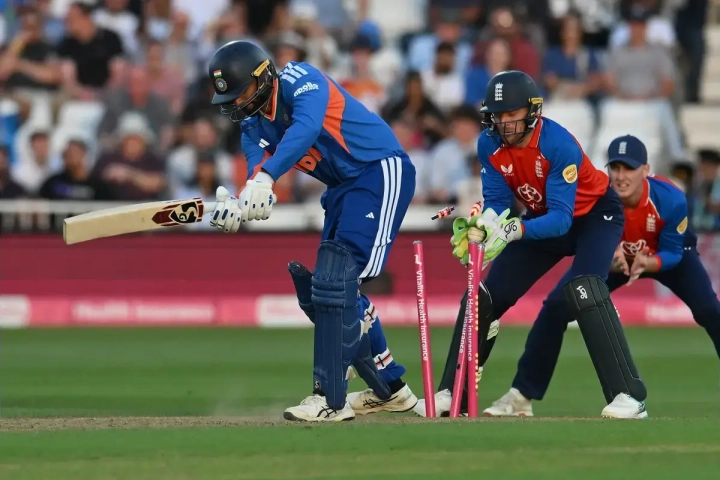
Facing a monumental required run rate of over ten runs per over from the outset, the chasing side required a flawless start. Instead, they walked directly into a buzzsaw of express pace and relentless accuracy. The pursuit completely collapsed before it ever genuinely began, resulting in a historically catastrophic batting card. The visitors were sensationally bundled out for a paltry 76 in just 11.4 overs, rendering the contest a completely one-sided affair.
The chief architect of this spectacular demolition was Josh Tongue. Bowling with terrifying hostility and extracting steep, uncomfortable bounce from the Trent Bridge surface, Tongue dismantled the top and middle order with surgical precision. He returned astonishing, career-best T20I figures of 4 for 28 from his four continuous overs. For his devastating, match-defining spell that completely broke the back of the chase, Tongue was rightfully awarded the official Player of the Match accolade.
Operating in tandem with Tongue, Jofra Archer provided a similarly lethal threat from the opposite end. The express paceman claimed 3 for 29 in his three overs, constantly rushing the batters and offering absolutely no respite. Together, the opening pair created an environment of sheer panic in the middle, inducing a procession of frantic strokes and inevitable dismissals.
Wonderkid’s Cameo Amidst the Rubble
Amidst the ruins of the collapsed innings, a brief, fleeting moment of spectacular defiance emerged from debutant Vaibhav Sooryavanshi. Billed as a generational wonderkid, the youthful batter provided a stunning glimpse of his immense potential. Confronting the intimidating pace of Archer, Sooryavanshi remarkably dropped to one knee and effortlessly scooped the fast bowler over fine leg for an outrageous six. He followed it up with another massive maximum, racing to 13 from just five deliveries at an astronomical strike rate of 260.00. However, the fairytale was exceptionally short-lived, as his unbridled aggression led to his rapid downfall just moments later.
Outside of the young debutant’s brief fireworks, the scorecard made for incredibly grim reading. Ishan Kishan managed a scratchy 13 from nine balls, while Axar Patel (10) and Abhishek Sharma (10) were the only other individuals to reach double figures. Captain Shreyas Iyer’s struggles with the bat continued, falling for a mere 5 runs as the mounting pressure forced desperate shot selection.
Once the primary pacemen had laid waste to the recognised batters, the spin duo of Adil Rashid and Will Jacks were introduced to efficiently mop up the tail. Rashid required just 16 deliveries to sweep through the lower order, claiming 2 for 14 with his trademark variations. Jacks needed even less time, securing a wicket for just five runs in his two overs, wrapping up the match long before the stadium lights had fully taken effect.
Second Innings: Top Batting Performances
| Batter | Runs | Balls | Strike Rate | Fours | Sixes |
| Vaibhav Sooryavanshi | 13 | 5 | 260.00 | 0 | 2 |
| Ishan Kishan | 13 | 9 | 144.44 | 1 | 1 |
| Axar Patel | 10 | 4 | 250.00 | 1 | 1 |
Second Innings: Key Bowling Figures
| Bowler | Overs | Runs Conceded | Wickets | Economy |
| Josh Tongue | 4.0 | 28 | 4 | 7.00 |
| Jofra Archer | 3.0 | 29 | 3 | 9.67 |
| Adil Rashid | 2.4 | 14 | 2 | 5.25 |
Series Implications and the Road Ahead
This crushing 125-run triumph carries immense short-term and long-term implications for both squads. For the hosts, the complete nature of the performance will be deeply satisfying. Their aggressive batting philosophy paid massive dividends, and their fast-bowling reserves look incredibly potent ahead of future global ICC tournaments. By securing a 2-0 series lead, they have mathematically ensured they will not lose this bilateral contest, allowing them the freedom to potentially experiment with their lineup in the final two fixtures.
Conversely, the visiting side finds themselves in a state of crisis management. The sheer magnitude of the defeat, coupled with their inability to bat out even twelve overs, will prompt serious questions regarding their tactical approach and mental resilience. Captain Shreyas Iyer is facing mounting scrutiny, having now suffered defeats in three of the four matches he has overseen since assuming the leadership role. The management team has a monumental task ahead to rebuild shattered confidence before the series moves to Bristol. The fourth T20I at Gloucestershire Cricket Ground on Thursday presents a desperate opportunity for redemption, but overcoming the psychological scarring of this Trent Bridge demolition will require a monumental collective effort.