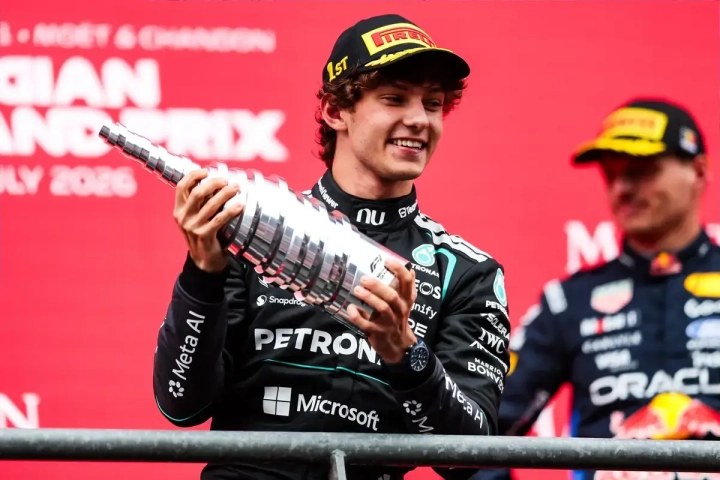
In the heart of the Ardennes forest, where legends are forged and championship dreams frequently collide with brutal reality, the 2026 Formula One season delivered another seismic shift. Nineteen-year-old Italian prodigy Andrea Kimi Antonelli secured a commanding victory at the Belgian Grand Prix for Mercedes on Sunday afternoon. In doing so, he extended his lead at the summit of the World Drivers’ Championship to a formidable 45 points over his closest active challenger, Ferrari’s Lewis Hamilton.
But while Antonelli basked in the glory of his sixth win in ten rounds, the grim juxtaposition in the Mercedes garage was impossible to ignore. His teammate, George Russell, suffered a catastrophic first-lap retirement following a bitter collision with Hamilton, dealing a crushing blow to the Briton’s own title aspirations.
The First-Lap Drama at Les Combes
The Circuit de Spa-Francorchamps, a daunting 7.004-kilometre ribbon of undulating asphalt, is notorious for its opening-lap theatre. Sunday proved no exception. Starting from pole position after a blistering 1:44.361 lap in qualifying, Antonelli found himself immediately under pressure from the Red Bull of Max Verstappen. Verstappen, starting second, executed a sublime getaway, deploying the raw power of his Honda unit to snatch the lead as the cars screamed through the compression of Eau Rouge and crested Raidillon.
However, the real controversy ignited further back in the pack. Russell, starting third, immediately complained of a critical power deployment issue. Exiting the La Source hairpin, the Briton reported being “30% to 40% down on battery,” leaving him vulnerable on the long drag up the Kemmel Straight. As the pack slipstreamed towards Les Combes, Russell was swamped by the duelling Ferraris of Charles Leclerc and Lewis Hamilton.
Attempting to aggressively reclaim his lost momentum around the outside on the brakes, Russell made terminal contact with Hamilton through the right-left chicane sequence. The impact pitched the Mercedes violently into the gravel trap, instantly ending Russell’s race and resulting in a brief deployment of the Safety Car. The stewards deemed Hamilton at fault, slapping the seven-time World Champion with a five-second time penalty.
For Russell, who entered the weekend a surmountable 25 points adrift of Antonelli, the zero-point return is a devastating setback. He now trails his teenage teammate by 50 points. Reflecting on the incident, a frustrated Russell refused to publicly condemn his former teammate, labelling it a “racing incident,” but lamented the operational failures that left him vulnerable in the first place.
The Challenge of Spa-Francorchamps
To triumph at Spa-Francorchamps is to join an elite pantheon of motorsport legends. Originally constructed in 1921 using the public roads connecting Francorchamps, Malmedy, and Stavelot, the circuit is hallowed ground. Although shortened from its terrifying 14.9-kilometre origins to the modern layout in 1979, it remains the longest track on the Formula One calendar. Drivers are subjected to immense G-forces through the legendary sweep of Eau Rouge, only to demand supreme heavy-braking stability into the Bus Stop chicane at the lap’s conclusion. Furthermore, the notorious microclimate of the Ardennes region always threatens to upend the competitive order.
Fortunately for the strategists on the pit wall, the 2026 edition of the 44-lap race was spared the chaotic interventions of Mother Nature. The dry conditions placed a premium on pure aerodynamic efficiency and tyre preservation. Antonelli’s ability to manage his Pirelli rubber over the race distance, specifically after the intense pressure of the Safety Car restart, was the hallmark of his victory.
Antonelli’s Masterclass in Composure
With his primary title rival effectively neutralised in the gravel trap, the burden of expectation rested squarely on Antonelli’s youthful shoulders. Despite Verstappen’s early heroics, the Dutchman’s stint at the front was remarkably brief. Antonelli, exhibiting the calm, calculated race craft of a seasoned veteran, shadowed the Red Bull before decisively reclaiming the lead. From that moment, the Italian dictated the tempo with ruthless efficiency.
The strategic complexion of the race shifted dramatically when a Virtual Safety Car was deployed midway through the grand prix. Ferrari rolled the strategic dice, pitting Leclerc to give the Monégasque track position. Leclerc briefly assumed the lead, forcing Antonelli to go on the offensive. Unfazed by the tactical curveball, the Mercedes driver meticulously hunted down the scarlet machine, eventually overtaking Leclerc and managing his tyres exquisitely to the chequered flag. Antonelli crossed the line 1.952 seconds clear of Leclerc, claiming a vital triumph, his first since the Monaco Grand Prix in May.
Red Bull’s Milestone and Ferrari’s Mitigation
Behind the lead pair, Verstappen was forced to settle for third place. While the reigning champion could not match the sustained race pace of the Mercedes or the strategically vaulted Ferrari, his podium finish carried immense historical weight. Verstappen’s bronze medal secured Red Bull Racing their 300th podium finish in Formula One, a monumental achievement for the Milton Keynes-based outfit.
For Ferrari, Sunday was a day of damage limitation and missed opportunities. Leclerc drove a flawless, opportunistic race to secure second, but Hamilton’s afternoon was mired in controversy. Despite crossing the line in fourth, the Briton had to swallow the bitter pill of his five-second penalty for the Russell collision. Furthermore, Hamilton remains under a post-race investigation for an alleged unsafe release during his pitstop. Should the stewards hand down further sanctions, he could lose his fourth-place finish to McLaren’s Oscar Piastri, who crossed the line a mere 1.743 seconds behind Hamilton in fifth.
Midfield Heroics from Hadjar and Norris
Away from the sharp end of the grid, the Belgian Grand Prix witnessed several outstanding recovery drives that captivated the grandstands at Pouhon. Chief among them was Isack Hadjar in the second Red Bull. The Frenchman was relegated to 21st on the starting grid after taking on multiple new power unit elements. Undeterred, Hadjar unleashed a ferocious comeback, navigating the perilous midfield traffic to finish a staggering sixth. His relentless pace not only validated Red Bull’s aggressive engine penalty strategy but also underscored his growing maturity in the top flight.
Similarly, McLaren’s Lando Norris demonstrated tremendous resilience. Burdened by a ten-place grid penalty that dropped him to 13th despite a stellar qualifying effort, the Briton carved his way through the pack to secure seventh place. It was a vital haul of six points for McLaren, heavily supplementing Piastri’s top-five finish.
Further down the order, the battle for the final points-paying positions was fiercely contested. Gabriel Bortoleto delivered a mature, composed drive to secure eighth place for the Audi F1 Team, continuing the German manufacturer’s encouraging 2026 campaign. Arvid Lindblad put his Racing Bulls machine into ninth, while Franco Colapinto snatched the final point for Williams in tenth, fending off the Alpine of Pierre Gasly and the second Racing Bulls entry of Liam Lawson in a tense concluding stint.
Title Implications and the Road Ahead
As the paddock dismantles its hospitality suites and the transporters depart the serene Ardennes landscape, the narrative of the 2026 World Championship has been irrevocably altered. Andrea Kimi Antonelli’s victory at Spa-Francorchamps is not merely a statistical addition to his rapidly expanding CV; it is a profound psychological blow to the rest of the grid. To win six of the opening ten rounds at the age of nineteen is unprecedented. His 45-point buffer over Hamilton provides a vital cushion as the European leg of the season reaches its zenith.
Conversely, George Russell faces an uphill battle of mountainous proportions. The margin for error has completely vanished. The Briton must quickly reset and find a way to consistently overcome his teammate’s raw, unbridled pace, whilst hoping the mechanical and operational gremlins that plagued his launch out of La Source are permanently banished.
Formula One now turns its attention to the tight, twisting confines of the Hungaroring for the Hungarian Grand Prix next weekend. The stark contrast between the high-speed demands of Spa and the aerodynamic rigours of Budapest will present an entirely new challenge. Whether Antonelli can maintain his supreme momentum on the slower, technical circuit, or if Ferrari and Red Bull can mount a concerted counter-attack, remains the defining question of a breathtaking 2026 campaign.