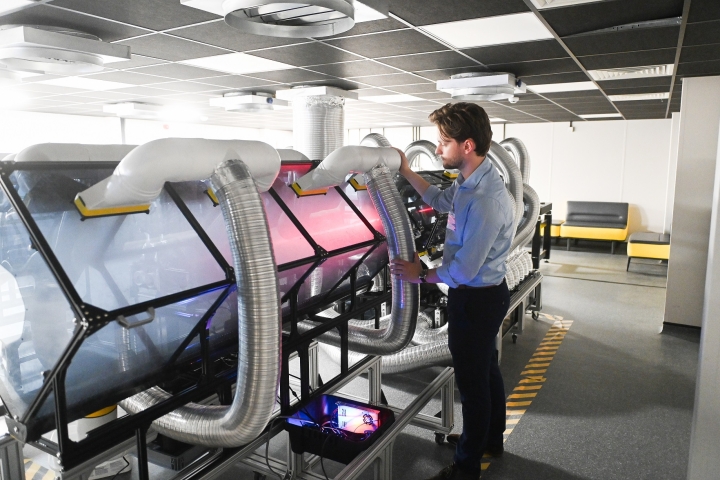
The UK’s largest indoor optical research facility officially opened at the University of Suffolk’s DigiTech Centre today – a laboratory which is set to play a key role in supporting future space missions and next-generation secure quantum communications.
The Quantum Optics Discovery (QOD) Lab, based at BT Adastral Park, is part of the Space East cluster, and will enable testing of laser communication systems, known as free space optics, through turbulent atmospheric conditions such as rain, fog and wind.
Optical communications use light to carry information vast distances and are more secure than those travelling on cable-based infrastructure.
In addition, the facility will enable testing of real-world laser communications from an optical ground station on site, via satellites in space and received back down to Earth at Heriot-Watt University in Edinburgh.
Grant-funded by the UK Space Agency under its Space Cluster Infrastructure Fund (SCIF), which includes match funding from the project’s commercial and academic partners, the £6.2million project is the first of its kind in the East of England.
The facility will enable research projects and commercial testing opportunities for a wealth of sectors in need of secure and reliable communications, such as emergency services, financial, security, disaster zone recovery, and many more.
In addition, it will help test communications systems which will reduce the reliance on existing cable-based infrastructure.
The facility’s lab includes a free space optics turbulence simulator, which can direct a laser either horizontally or vertically and test the beam in modular rain, fog, temperature and wind controls, to create a controlled environment of testing real-world scenarios.
According to project leaders, the facility can even test wind speeds up to hurricane-level conditions.
Honeywell Aerospace’s on-site transportable optical ground station meanwhile can connect light signals from the Quantum Encryption and Science Satellite (QEYSSAT) and QKDSat satellite in space, before returning the data back to Earth to Adastral Park and Heriot-Watt University’s optical ground station in Edinburgh. That will provide the opportunity to test the communications in live atmospheric conditions.
The tests that can be conducted at the site in real weather conditions could help support the development of next-generation networks, secure communications and even future space missions.
The project helps meet the Government’s national quantum and space strategies, including ambitions to deploy the most advanced quantum network at scale by 2035.
Furthermore, the facility will be available under commercial agreements for testing by firms needing to utilise free space optics communications, and is set to facilitate a host of research projects, including PhD and postdoctoral research opportunities at the University of Suffolk.
At the official launch event on Thursday afternoon, the new facility was opened by University of Suffolk Vice-Chancellor, Professor Jenny Higham, and project partners alongside invited guests.