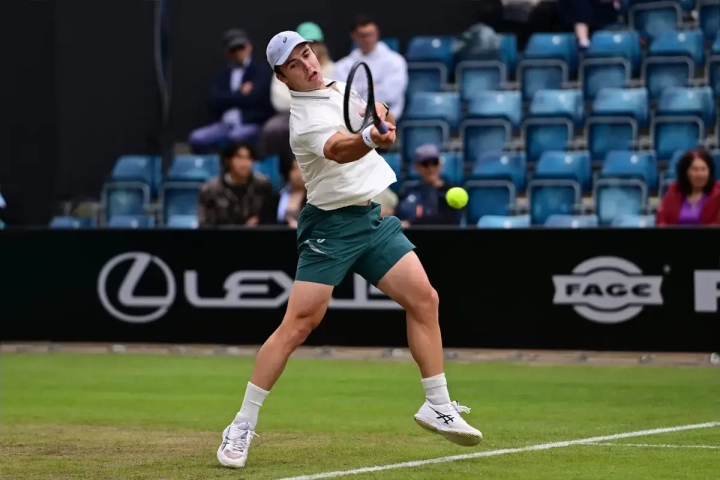
Wednesday, 8 July 2026, will forever be etched into the folklore of British tennis. Just two days after dispatching Grigor Dimitrov in a gruelling five-set thriller that brought Centre Court to its feet, 23-year-old Arthur Fery has achieved the genuinely extraordinary. The British wildcard, a young man who grew up a mere five-minute walk from the All England Club gates, has stormed into the Wimbledon semi-finals following a breathtaking 6-4, 7-6 (4), 6-0 demolition of Italian ninth seed Flavio Cobolli.
In a tournament that consistently demands greatness, Fery has delivered nothing short of a miracle. He becomes the first male wildcard to reach the final four at SW19 since Goran Ivanisevic achieved the feat on his way to famously lifting the trophy in 2001. Entering the fortnight ranked 114th in the world, Fery’s fairytale run has completely captivated a nation, proving that his victories over seasoned veterans were no stroke of luck.
Today, beneath the scorching afternoon sun in south-west London, the Stanford University alumnus produced the most complete, devastating performance of his professional career, obliterating an in-form opponent and sending an emphatic message to the rest of the tennis world.
A Centre Court Masterclass
The quarter-final clash against Cobolli was widely billed as Fery’s ultimate test of physical and mental endurance. Having spent over eight hours on court combined in his previous two matches against Zizou Bergs and Dimitrov, questions swirled regarding how much fuel the young Briton had left in the tank. Cobolli, an explosive baseliner who reached the final of the French Open just last month, was heavily favoured by the bookmakers to overpower the local hero.
However, from the very first strike of the ball, Fery dictated the tempo. The opening set was a masterclass in tactical discipline. Fery utilised his trademark defensive slice to absorb Cobolli’s heavy power, repeatedly forcing the Italian into uncomfortable, awkward positions. The set remained firmly on serve until the critical tenth game. At 5-4, Fery sensed blood. Earning his first break point of the match after a brilliant cross-court exchange forced Cobolli out wide, Fery watched as the Italian sprayed a backhand beyond the baseline. The Briton let out a guttural roar, claiming the first set 6-4 and sending Centre Court into an absolute frenzy.
The second set provided the crucial turning point of the contest. Cobolli, stung by the late break, came out swinging. Exploiting a momentary dip in Fery’s concentration, which included two rare double faults, the Italian broke to love and swiftly established a 2-0 lead.
In previous years, an inexperienced wildcard might have crumbled under the resurgence of a top-ten player. Fery, however, has demonstrated an almost frightening level of mental fortitude throughout this tournament. He immediately broke back, steadying the ship and dragging the set into a tiebreak. In the crucible of the breaker, Fery’s intelligence shone through. Reading Cobolli’s serves with eerie precision, he forced the Italian into a series of unforced errors, eventually clinching the tiebreak 7-4. The psychological damage inflicted on Cobolli was profound and immediately visible.
The third set was not a contest; it was a coronation. Breaking the Italian’s spirit entirely, Fery played with the aggressive swagger of a seasoned Grand Slam champion. He painted the lines, rushed the net with impeccable timing, and served with a venom that left Cobolli utterly bewildered. The 6-0 “bagel” in the third set took merely 28 minutes to complete, a shocking, utterly dominant end to a match that promised a grueling battle but delivered a British masterclass.
Rewriting the History Books
To contextualise the sheer magnitude of Fery’s achievement, one must look closely at the history books. By reaching the semi-finals, Fery is the lowest-ranked player to make the last four at Wimbledon since Ivanisevic (who was ranked 125th) a quarter of a century ago. (While Nick Kyrgios reached the quarter-finals in 2014 ranked 144th, he fell short of the semis).
Furthermore, this incredible run guarantees a seismic shift in the British tennis hierarchy. Having started the 2026 calendar year ranked 185th, and entering Wimbledon at 114th, Fery is projected to surge to at least world No. 63 on Monday morning. This astronomical rise instantly makes him the new British number two, leapfrogging the established guard and placing him firmly behind only Cameron Norrie.
The Cobolli Rivalry and Tactical Brilliance
For the analytical observer, Fery’s victory over Cobolli was not entirely unprecedented. The pair had previously crossed paths in January during the first round of the 2026 Australian Open. On that occasion, Fery, who had battled his way through the qualifying draw in Melbourne, dismantled the then-22nd-ranked Italian in straight sets, 7-6 (1), 6-4, 6-1.
Speaking before today’s match, Fery had noted, “I played really well in Australia. Felt like I dominated the match. So we’ll use that experience for Wednesday.”
He was incredibly true to his word. Guided by his Dutch coach, Jeroen Benard, Fery executed a carbon copy of his Melbourne game plan. He neutered Cobolli’s forehand with low, skidding slices, approached the net to shorten the points, and relied heavily on his tennis IQ. As British doubles specialist Jamie Murray aptly observed earlier in the week, “He’s just a smart player. He reads the game very well, better than most.”
Resilience Forged in Adversity
Perhaps the most extraordinary aspect of Fery’s run to the final four is the adversity he has overcome simply to be on the court. The 23-year-old’s progress earlier in the year was severely derailed by a bone bruise injury to his arm, the exact same debilitating issue that forced Jack Draper to withdraw from the tournament on the eve of Wimbledon. The injury kept Fery sidelined for nearly two months after his Australian Open triumph, eating into valuable development time.
Yet, he has arrived at SW19 looking physically robust and mentally impenetrable. His path to the semi-finals is a testament to an absolute refusal to be beaten.
Third Round (vs. Zizou Bergs): Fery found himself down a double break in the fourth set and staring elimination in the face, before clawing his way back to win in a dramatic fifth-set tiebreak.
Round of 16 (vs. Grigor Dimitrov): He was again a break down in the fourth set, only to stage a monumental comeback and secure another exhausting fifth-set tiebreak victory.
To follow those exhausting marathons with a clinical, straight-sets dismantling of a top-ten player speaks volumes about his physical conditioning, his recovery protocols, and his unrelenting grit.
Former British No. 1 Greg Rusedski noted this exceptional toughness, stating: “I like his swagger, his fortitude, the way he never gives up… he finds a way to win.”
The US College System Blueprint
Fery’s mental toughness can be heavily attributed to his developmental route. Born in Sèvres, France, but raised in London since he was a month old, Fery opted against plunging straight into the unforgiving depths of the professional Futures tour as a teenager. Instead, he attended Stanford University, competing in the highly pressurised NCAA collegiate system.
College tennis in the United States is renowned for its raucous atmospheres, intense team dynamics, and the absolute necessity of performing under immense collective pressure. It is a breeding ground for resilience. Fery honed his craft in this environment, learning how to manage momentum swings and handle hostile crowds. It is no coincidence that when Centre Court has demanded a response, Fery has looked entirely at home, treating the sport’s most famous amphitheatre with the composed swagger of a collegiate veteran.
Looking Ahead: The Zverev Challenge
The fairytale now faces its most imposing chapter yet. Awaiting Fery in Friday’s semi-final is the formidable figure of Alexander Zverev. The German second seed, fresh off his maiden French Open victory, booked his place in the final four with a bruising victory over American Taylor Fritz over on No. 1 Court.
Zverev represents a monumental step up in weight class. Standing at 6ft 6in, the German possesses one of the most devastating first serves in the game and a baseline consistency that has dismantled the world’s best. He will present a vastly different tactical and physical challenge to Cobolli.
Yet, if this fortnight has taught the tennis world anything, it is that Arthur Fery thrives when the odds are heavily stacked against him. “I’m just going to stick to what I’ve been doing, just keep believing in myself, not letting go of matches, and we’ll see where that takes me,” Fery insisted. “I’m not going to change anything now. It’s working, I feel good.”
As the shadows lengthen across the SW19 lawns, the atmosphere in London is utterly electric. The boy who went to King’s College School, a stone’s throw from the All England Club gates, is just two matches away from sporting immortality. Whatever happens on Friday against Zverev, Arthur Fery’s 2026 Wimbledon campaign is a triumph of perseverance and tactical intelligence. The local boy has conquered Centre Court, shattered the rankings, and proven that the romance of the wildcard fairytale is very much alive.