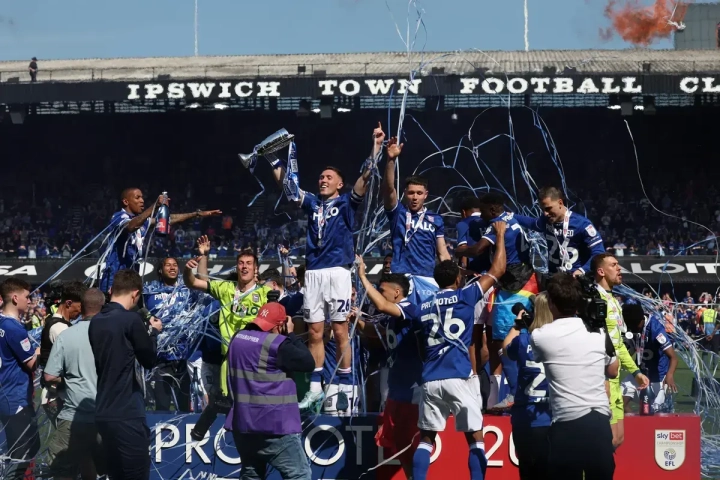
When Ipswich Town secured their immediate return to the Premier League on 2 May 2026 with a decisive 3-0 victory over Queens Park Rangers, the celebrations at Portman Road were laced with a profound sense of determination. Having endured the bitter pill of relegation at the end of the 2024/25 campaign, the Tractor Boys bounced back at the very first time of asking. Yet, what has followed over the past two months has been nothing short of extraordinary.
As the 2026 summer transfer window enters its final weeks, Ipswich Town have emerged as one of the most aggressive and financially potent forces in European football. Backed by their deep-pocketed ownership group, the Suffolk club has sanctioned an astonishing spending spree exceeding £120 million. The strategy is clear: the hierarchy is leaving absolutely nothing to chance in their quest to establish Ipswich as a permanent fixture in the English top flight.
A New Managerial Era Under Gary O’Neil
To fully contextualise Ipswich Town’s staggering summer business, one must first examine the significant upheaval that occurred in the dugout. Following the climax of their promotion-winning Championship campaign, the club was rocked by the departure of Kieran McKenna. The 40-year-old Northern Irishman, who had masterminded the club’s remarkable ascent from League One and their subsequent immediate return to the Premier League, stepped down from football management to focus on his family.
Faced with the monumental task of replacing a modern club legend, the Ipswich board moved decisively. On 23 June 2026, Gary O’Neil was unveiled as the new manager on a three-year deal. Arriving from French Ligue 1 outfit Strasbourg, O’Neil brought a reputation for tactical pragmatism and a deep understanding of Premier League survival dynamics. However, the board recognised that O’Neil would require significant financial backing to implement his vision. They delivered on that promise almost immediately.
Shattering Records: Emersonn and the Attacking Overhaul
The hallmark of a newly promoted side attempting to survive the Premier League is often a marquee, statement signing. Ipswich Town delivered exactly that on 8 July 2026, obliterating their club transfer record to sign Brazilian forward Emersonn from Toulouse.
Commanding a fee of £24 million plus add-ons, the 22-year-old represents a massive coup for the Tractor Boys. Emersonn arrives with a burgeoning reputation as a dynamic, clinical centre-forward capable of operating across the frontline. His acquisition demonstrates a dramatic rise in Ipswich’s transfer ceiling, proving they can attract highly coveted continental talent away from established European contenders.
But Emersonn was merely the tip of the spear. Recognising the need for electric pace and one-on-one threat in wide areas, the club invested heavily in Abdul Fatawu. The 22-year-old Ghanaian winger was lured from Leicester City for a staggering £20 million. Fatawu’s directness and ability to stretch opposition defences will be crucial to O’Neil’s counter-attacking blueprint.
Adding further continental flair to the flanks, Ipswich secured 20-year-old Norwegian prospect Sindre Walle Egeli from Nordsjaelland for £17.5m (€20m). To round out the attacking reinforcements, Japanese international Daizen Maeda arrived from Celtic for £8.5 million, providing relentless pressing and vital top-flight experience, while Chuba Akpom saw his successful loan spell from Ajax converted into a permanent £7 million transfer.
Rebuilding the Engine Room and Defensive Foundations
While the attacking investments have captured the headlines, O’Neil’s strategy has been equally focused on structural solidity. The pace and physicality of the Premier League midfield are notoriously unforgiving, prompting Ipswich to act aggressively in the market.
On 4 August 2026, Ipswich completed the £16 million signing of Portuguese defensive midfielder Florentino Luís from Burnley. Florentino brings exceptional ball-winning ability and positional discipline, providing a vital shield for the backline. Just days later, on 8 August, the midfield was further fortified with the addition of Saša Lukić. The Serbian international joined from Fulham for £9 million, adding crucial progressive passing and top-flight pedigree to the engine room.
The defensive unit has also undergone a comprehensive overhaul. With former number-one goalkeeper Arijanet Muric departing for Italian side Sassuolo in a £6 million deal after a mixed spell at Portman Road, the club moved to secure Dutch giant Kjell Scherpen. The 6-foot-8 shot-stopper was acquired from Union Saint-Gilloise for £8.5 million, alongside 21-year-old compatriot Kayne van Oevelen from FC Volendam (£3.4 million).
In front of the goalkeepers, the central defence has been heavily bolstered. Issa Diop, an imposing Premier League veteran, was signed from Fulham for £8.5 million [8]. The 29-year-old brings a wealth of experience required to navigate the rigours of a relegation battle. Furthermore, Cédric Kipré’s loan from Reims was made permanent for £2.16 million, ensuring continuity for a player who contributed heavily to their Championship promotion.
The Financial Mechanics: How Are Ipswich Funding This?
The obvious question surrounding Ipswich Town’s £120 million-plus outlay is one of financial sustainability. How does a club that has yo-yoed between divisions over the past three seasons suddenly boast the spending power to rival established Premier League heavyweights?
The answer lies in a combination of long-term strategic player trading and robust ownership backing. As reported in Ipswich Town’s recent financial disclosures, the club has become increasingly proficient at generating profit through player sales. The most notable example is Liam Delap. After investing £15 million to bring the striker from Manchester City in the summer of 2024, Delap impressed during their relegation campaign, scoring 12 Premier League goals. His performances triggered a £30 million move to Chelsea in 2025, generating significant underlying profit that has subsequently been reinvested into the current squad.
Additionally, the immense broadcasting revenues associated with returning to the Premier League provide a substantial financial buffer. The club’s ownership, ORG, led by Ed Schwartz, has clearly calculated that aggressive upfront investment is the most mathematically viable method of avoiding the catastrophic financial losses associated with an immediate return to the Championship. By front-loading their spending, Ipswich are attempting to bridge the daunting quality gap that exists between the second tier and the elite.
Summer 2026 Completed First-Team Signings
The sheer volume of incoming business at Portman Road is staggering. Below is a comprehensive breakdown of the major permanent additions to Gary O’Neil’s squad this summer:
| Player | Position | Previous Club | Reported Fee | Date Signed |
| Emersonn | Centre-Forward | Toulouse | £24.0m | 8 July 2026 |
| Abdul Fatawu | Right Winger | Leicester City | £20.0m | 21 July 2026 |
| Sindre Walle Egeli | Right Winger | Nordsjaelland | £17.5m | Summer 2026 |
| Florentino Luís | Def. Midfielder | Burnley | £16.0m | 4 August 2026 |
| Saša Lukić | Central Midfielder | Fulham | £9.0m | 8 August 2026 |
| Issa Diop | Centre-Back | Fulham | £8.5m | 22 July 2026 |
| Kjell Scherpen | Goalkeeper | Union SG | £8.5m | 28 July 2026 |
| Daizen Maeda | Left Winger | Celtic | £8.0m | 25 July 2026 |
| Chuba Akpom | Centre-Forward | Ajax | £7.0m | 1 July 2026 |
| Kayne van Oevelen | Goalkeeper | FC Volendam | £3.4m | 21 July 2026 |
| Cédric Kipré | Centre-Back | Reims | £2.16m | 1 July 2026 |
Note: Fees are estimated based on widespread media reports and club disclosures.
Looking Ahead: The Pressure of the Price Tag
While the excitement surrounding Portman Road is palpable, the reality of the Premier League means that hefty price tags guarantee nothing. The history of the English top flight is littered with newly promoted clubs who “won the transfer window,” only to suffer the indignity of relegation the following May.
Gary O’Neil faces the immense challenge of rapidly integrating an influx of international talent into a cohesive tactical unit. Over half of his anticipated starting XI could consist of players who have never shared a pitch before this summer. The language barriers, differing tactical educations, and the unique physical demands of English football will all pose significant hurdles in the opening weeks of the season.
However, the profile of the signings suggests a cohesive recruitment strategy rather than a panicked trolley dash. By targeting a blend of youthful potential, such as Emersonn, Egeli, and Fatawu, and battle-hardened Premier League experience in the form of Diop, Lukić, and Florentino, Ipswich have attempted to construct a balanced squad capable of surviving the grind of a 38-game season.
As the transfer window edges toward its conclusion, Ipswich Town have undoubtedly made the loudest statement of any newly promoted side. They have emphatically discarded the underdog narrative, choosing instead to flex their financial muscle and challenge the established order. Whether this £120 million gamble results in long-term Premier League stability or a costly miscalculation will be one of the defining narratives of the 2026/27 season. For now, the Tractor Boys are firmly in the fast lane.