
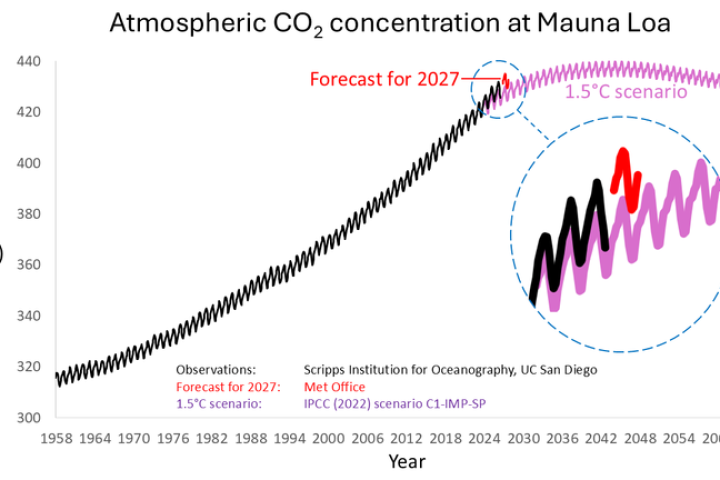
The Met Office forecasts an unusually large rise in atmospheric carbon dioxide (CO₂) for 2027, diverging further from 1.5°C-compatible pathways as strong El Niño amplifies the human-driven rise by weakening natural carbon sinks.
The annual average CO₂ concentration at the Mauna Loa Observatory, in Hawaii, is projected to rise by 3.51 ± 0.52 parts per million (ppm) in 2027 compared with the estimated 2026 level*, reaching a new high of 432.2 ± 0.5 ppm. The rise is the largest annual increase ever forecast by the Met Office and is comparable to the record increase of 3.57 ppm observed in 2024, which was boosted by exceptional wildfire emissions.
Particularly large rise in carbon dioxide
Met Office scientist Emily Wright, who worked on the forecast, said: “We’re expecting a particularly large rise in CO₂ for 2027, and the strong El Niño is playing an important role in that. Human emissions are still driving the long-term increase, but plants, soils and oceans normally absorb some of the CO₂ we release. El Niño events reduce how much they absorb overall, leaving more CO₂ in the atmosphere.”
El Niño can bring hotter and drier conditions to tropical land regions, weakening the ability of forests and other vegetation to absorb CO₂ from the atmosphere. Areas at increased risk of dry conditions during the current El Niño include areas of Central America, west Pacific nations and tropical South America.
To estimate the CO2 rise without the influence of El Niño conditions, scientists ran the model again without the sea-surface temperature changes associated with El Niño. This produced an estimated increase of 2.57 ppm, considerably lower than the main forecast increase of 3.51 ppm when the influence of El Niño is taken into account.
Strong El Niño event
Richard Betts, Head of Climate Impacts Research in the Met Office Hadley Centre, said: “Natural climate variability can substantially alter annual rates of CO₂ rise, particularly during strong El Niño events. But behind this year-on-year variability is the long-term trend from human-caused emissions. To follow pathways consistent with limiting warming to 1.5°C, the underlying rate of CO₂ increase needs to slow substantially, but this forecast shows that the rate of rise remains too high.”
The graph shows how the latest forecast compares with C1-IMP-SP, an illustrative pathway from the Intergovernmental Panel on Climate Change (IPCC) focused on sustainable development, shown in purple. Across the IPCC’s 1.5°C-compatible pathways with little or no overshoot, the required average annual CO₂ rise during the 2020s ranges from 1.33 to 1.79 ppm per year, slower than the average rise of 2.41 ppm per year seen during the 2010s. However, between 2020 and 2025, the observed average was higher at 2.61 ppm per year. The latest forecast, shown in red, indicates an even faster rise in 2027, amplified by the effects of El Niño. Even without the effect of El Niño, the human-driven CO₂ rise would continue to follow this trend of exceeding 1.5°C-compatible scenarios.
El Niño and La Niña can influence the annual rate of increase in atmospheric CO₂, causing it to rise faster or slower from one year to the next. The Met Office accounts for this variability, alongside human-caused emissions, when producing its annual CO₂ forecast. This year’s particularly strong El Niño makes that natural influence especially important for the latest forecast.
The Mauna Loa measurements provide an essential long-term record of atmospheric CO₂, with changes in concentrations providing a useful guide to changes in the global average.
The Met Office Carbon Dioxide forecast has been produced since 2016.
The “Keeling Curve” record of atmospheric levels of carbon dioxide at Mauna Loa has been maintained by the Scripps Institution for Oceanography, University of California San Diego since 1958.
*The 2026 estimate uses observed CO₂ concentrations up to September 2026, with predicted monthly increases from the 2026 forecast used for October to December.