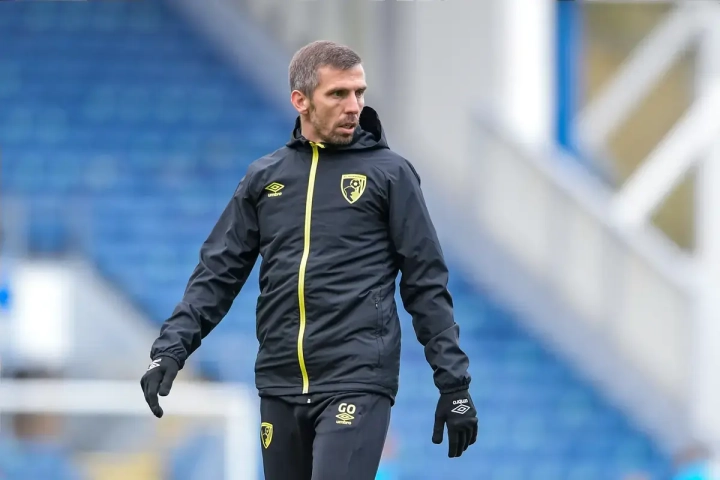
The dust has finally settled at Portman Road. Following a turbulent and emotionally charged few weeks that culminated in the shock departure of Kieran McKenna, Ipswich Town have officially unveiled their new manager. Stepping into the dugout to lead the Tractor Boys into their highly anticipated Premier League return is 43-year-old Gary O’Neil, who arrives on a three-year contract running until the summer of 2029.
The appointment marks a pivotal shift in philosophy for the Suffolk club. Becoming only the 20th manager in Ipswich’s storied 90-year professional history, O’Neil returns to English shores following an incredibly successful managerial stint in France with RC Strasbourg. While the departure of the man who orchestrated back-to-back promotions left a profound void, the swift and decisive capture of O’Neil signals that the Ipswich hierarchy are fiercely committed to ensuring their top-flight status is not a fleeting one.
Here is a comprehensive look at the rationale behind the appointment, the tactical shift fans can expect, and the monumental challenge that awaits O’Neil and his newly assembled backroom staff.
Moving On from the McKenna Miracle
To fully contextualise the importance of Gary O’Neil’s arrival, one must acknowledge the immense shadow he steps into. Kieran McKenna achieved nothing short of a modern footballing miracle at Portman Road, dragging a sleeping giant from the depths of League One to the promised land of the Premier League in just two full seasons. His decision to step away from the club earlier this summer, following the culmination of their promotion campaign, sent shockwaves through the fanbase.
However, football is an unforgiving and relentlessly forward-looking business. While McKenna’s swashbuckling, possession-heavy football was aesthetically beautiful and devastatingly effective in the English Football League (EFL), history is littered with newly promoted clubs who stubbornly adhered to expansive tactics in the Premier League, only to be brutally relegated. The board recognised that navigating the elite tier requires a different toolkit. They needed a manager with proven top-flight survival instincts, a leader capable of uniting a dressing room, and a tactician who understands how to extract points against vastly superior opposition.
Enter Gary O’Neil.
The Pedigree of Survival and Overachievement
Despite being only 43, O’Neil has rapidly built a reputation as one of the most astute and adaptable young managers in European football. His managerial CV is defined by a consistent ability to overachieve amidst chaotic circumstances and limited resources.
His baptism of fire came at AFC Bournemouth, where he took caretaker charge following a humiliating 9-0 defeat to Liverpool. Against all odds, he instantly stabilised the leaking defence, galvanised a fractured squad, and comfortably guided the Cherries to Premier League safety.
He replicated this feat at Wolverhampton Wanderers under even more extreme circumstances. Appointed just days before the start of the season amidst a financial crisis and a mass exodus of key players, O’Neil implemented a devastating counter-attacking system that safely steered Wolves away from the relegation zone.
Most recently, his tenure at RC Strasbourg proved his ability to navigate entirely new footballing cultures. In France, O’Neil showcased a different facet of his managerial repertoire, proving he is not merely a “firefighter” for struggling clubs. He masterminded deep, sustained runs in knockout competitions, guiding Strasbourg to the semi-finals of both the UEFA Europa Conference League and the Coupe de France.
Speaking to the club’s official website upon his unveiling, O’Neil’s enthusiasm was palpable:
“It is an honour to be appointed manager of this great football club. I have followed the progress the club has made over the last few years closely, and to now have the opportunity to lead Ipswich Town in the Premier League is something I am hugely excited by.”
He added, acknowledging the weight of the fanbase:
“There is a strong vision and ambition at this club, and I am fully aware of the responsibility that brings, given how much it means to its supporters and to the community of Ipswich and Suffolk. We all know the challenge ahead as we prepare for the season together, and I’m excited to meet everyone and get to work.”
Tactical Blueprint: What to Expect on the Pitch
Ipswich Town supporters should prepare themselves for a stark tactical evolution. The relentless, high-possession dominance that characterised the McKenna era will be replaced by a far more pragmatic, calculated, and resilient approach.
Flexibility Over Dogma
O’Neil’s greatest strength is his lack of tactical stubbornness. He is a managerial chameleon. While he frequently favours a 4-2-3-1 or a fluid 3-4-3 formation, his setups are heavily tailored to exploit the specific weaknesses of the upcoming opponent. If the opposition struggles against a high press, O’Neil will instruct his forwards to hunt in packs. If the opponent possesses elite ball-playing midfielders, he is entirely comfortable dropping his team into a compact, disciplined 5-4-1 mid-block to suffocate central passing lanes.
Becoming Comfortable Without the Ball
In the Premier League, newly promoted teams rarely dominate possession. O’Neil excels at teaching teams how to “suffer” out of possession without conceding high-quality chances. He places a massive emphasis on horizontal compactness, ensuring that the distances between his defenders and midfielders remain incredibly tight. For an Ipswich squad accustomed to dictating the tempo of matches, learning to maintain absolute concentration during long spells of defensive shape will be their most crucial pre-season objective.
Devastating Transitions
Just because O’Neil is pragmatic does not mean his teams are boring. At Wolves, his side was arguably one of the most dangerous counter-attacking outfits in the division. He achieves this by keeping his wingers narrow during defensive phases, allowing them to explode into the half-spaces the second possession is turned over. Ipswich boast exceptional wide players with blistering pace; under O’Neil, expect them to bypass congested midfields with rapid, vertical passes aimed directly into the channels.
The New Backroom Brain Trust
A manager is only as strong as the staff that surrounds him, and O’Neil has brought a highly respected, meticulously curated backroom team to Portman Road. Joining him from his time in France are Tim Jenkins, Neil Critchley, and Ed Ames.
This trio brings a wealth of complementary expertise. Neil Critchley, in particular, is a massive coup for Ipswich. Having previously managed in the EFL with Blackpool and Queens Park Rangers, and possessing an elite developmental background from his years leading the Liverpool Under-21s, Critchley’s presence will be invaluable. Ipswich possess one of the youngest squads in the division, and Critchley’s experience in bridging the gap between youth development and senior football will ensure the club’s emerging talents continue their upward trajectory.
Meanwhile, Tim Jenkins and Ed Ames are renowned for their analytical rigour, providing O’Neil with the granular data and opposition scouting necessary to formulate his trademark game-by-game tactical adjustments.
A Baptism of Fire: The Opening Fixtures
O’Neil and his newly assembled staff will have precious little time to implement their philosophy before the unforgiving reality of the Premier League sets in. The fixture computer has handed Ipswich a daunting, yet incredibly exciting, opening month to the 2026/27 campaign.
The era officially begins on Saturday, 22 August, when Ipswich host fellow promoted side Sunderland at Portman Road. This opening weekend clash is an absolute must-win. Against a side they know intimately from their Championship battles, O’Neil will need three points to immediately secure buy-in from the fanbase and establish Portman Road as a fortress.
Following the curtain-raiser, the difficulty level skyrockets. Ipswich will travel to Old Trafford the following weekend to face Michael Carrick’s Manchester United, a squad desperate to mount a title challenge in Carrick’s first full season as permanent boss. Immediately after that, O’Neil will welcome Andoni Iraola’s new-look Liverpool to Suffolk in early September.
It is precisely during these brutal early-season encounters against the established “Big Six” that O’Neil’s tactical pragmatism will prove its worth. Ipswich will not be expected to out-pass United at Old Trafford or go toe-to-toe with Liverpool’s intense pressing. They will be tasked with frustrating their opponents, absorbing pressure, and striking with lethal efficiency on the break, the exact blueprint O’Neil has perfected throughout his career.
The Final Verdict
The appointment of Gary O’Neil may not possess the romantic, fairytale quality of Kieran McKenna’s meteoric rise, but elite football rarely rewards sentimentality. Ipswich Town are stepping into an arena where financial disparities are vast and the margins for error are microscopic.
In O’Neil, the club’s ownership has secured a modern, analytical, and highly adaptable manager who knows exactly what it takes to survive and thrive in the Premier League. He boasts a proven track record of extracting every ounce of potential from underdog squads, marrying defensive resilience with razor-sharp attacking transitions.
As the players return for pre-season training and the countdown to the Sunderland clash begins, a new era is officially underway in Suffolk. The fairytale is over, but under Gary O’Neil’s meticulous guidance, the reality of Premier League survival looks more achievable than ever.