There are dates in the sporting calendar that feel destined to be remembered long after the final whistle has blown. Monday, 22 June 2026, will forever occupy a sacred place in footballing folklore. On a day of breathless drama at the Dallas Stadium in Arlington, Texas, the ultimate individual prize in international football, the all-time FIFA World Cup goalscoring record, was completely dismantled.
For twelve years, Miroslav Klose’s benchmark of 16 World Cup goals stood as the pinnacle of striking excellence. Yet, in a testament to unparalleled longevity and genius, that record was shattered by the established king of the sport. Lionel Messi, at 38 years of age, ascended to unprecedented heights, scoring his 17th and 18th World Cup goals to become the undisputed greatest goalscorer in the tournament’s storied history.
The Weight of History in Arlington
Going into Argentina’s Group J clash against a highly organised Austria side managed by Ralf Rangnick, the script seemed entirely pre-written. Sitting on 16 World Cup goals following his spectacular hat-trick against Algeria, Messi needed just a single strike to eclipse Klose. The atmosphere in Texas was electric, heavily populated by thousands of travelling Argentine supporters who sensed they were about to witness history.
However, the footballing gods initially demanded resilience. In the eighth minute, after Lautaro Martínez was clumsily brought down in the penalty area by Austrian defender Stefan Posch, Messi stepped up to the spot. It was the perfect opportunity to break the record early and settle his team’s nerves. Instead, in a moment that stunned the stadium, Messi uncharacteristically pulled his effort wide of the post.
For a lesser player, such a high-profile miss on the precipice of history might have derailed their performance. For Messi, it simply served as a reset button. He began to dictate the tempo of the game, dropping deeper into midfield to orchestrate play, probing the Austrian defence, and waiting for the precise moment to strike.
The Spirit of 1986 and the Breakthrough
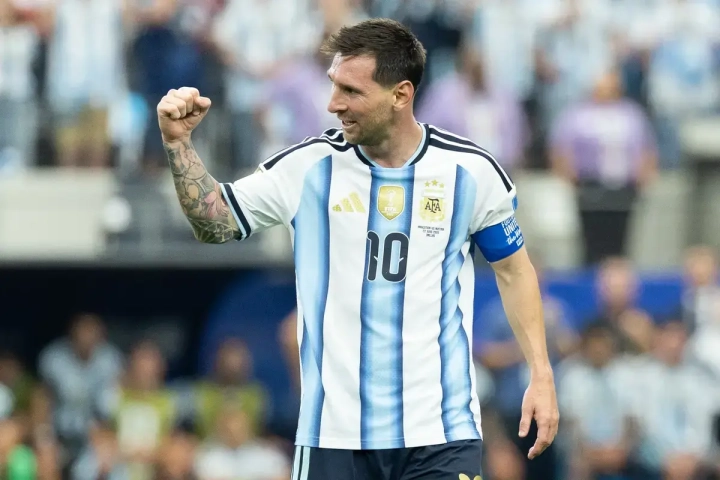
The redemption, when it arrived in the 38th minute, was spectacular. The buildup play was a quintessential display of Argentine fluidity. An intelligent dummy from forward Thiago Almada completely unpicked the Austrian backline, allowing Facundo Medina’s perfectly weighted pass to fall into Messi’s path. Without breaking stride, the captain ruthlessly swept the ball past Austrian goalkeeper Alexander Schlager and into the bottom corner.
With that single, fluid motion, the maestro scored his 17th World Cup goal. The poetry of the moment was profound. Messi’s record-breaking strike occurred exactly 40 years to the day after Diego Maradona scored his iconic “Goal of the Century” against England at the 1986 World Cup in Mexico City. To surpass the all-time goalscoring record on the anniversary of Argentina’s most famous footballing moment felt like an act of divine sporting intervention.
The Clincher and the Six-Match Club
Not content with merely breaking the record, Messi ensured that Austria had no route back into the match. Despite resolute defending from David Alaba and Kevin Danso, and a spirited midfield display from Marcel Sabitzer on his 100th international appearance, Austria could not find an equaliser.
Deep into second-half stoppage time (90+5′), as Austria pushed bodies forward in a desperate search for a leveller, Messi capitalised on the fractured defensive line. He hammered home his second goal of the match, securing a 2-0 victory for the reigning champions and taking his overall tally to an astonishing 18 goals.
That final strike did more than just inflate his record; it placed him in one of the most exclusive clubs in world football. Messi now joins France’s Just Fontaine (1958) and Brazil’s Jairzinho (1970) as the only players in history to score in six consecutive World Cup matches. His streak, which began in the knockout stages of the 2022 tournament against Australia, the Netherlands, Croatia, and France, has now seamlessly continued into 2026 against Algeria and Austria.
A Legacy Redefined
The achievement forces a fundamental re-evaluation of Messi’s legacy. For much of his career, he has been celebrated primarily as the ultimate playmaker, a master of spatial awareness, dribbling, and creation. His goalscoring, while always prolific, was often viewed as a byproduct of his overall attacking brilliance rather than his sole defining trait.
Yet, by surpassing the likes of Ronaldo (15), Gerd Müller (14), and Just Fontaine (13) to claim the outright World Cup record, Messi has cemented his status not just as the greatest player of all time, but as the most effective World Cup marksman the game has ever seen. As Lionel Scaloni’s defending champions progress to the Round of 32 from Group J, the rest of the world is left to wonder just how high Messi can set the bar before he finally decides to step off the global stage.