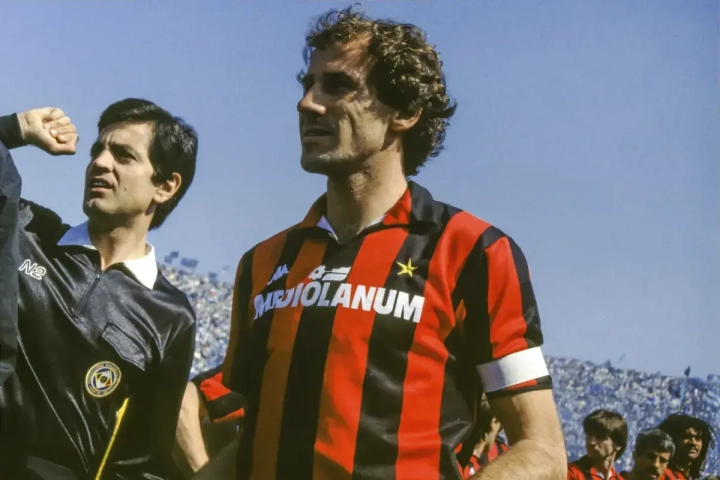
The global footballing community is united in profound grief following the heartbreaking announcement that Franco Baresi, the legendary AC Milan and Italy defender, has died at the age of 66. The iconic sweeper, widely regarded as one of the finest defensive minds in the history of the sport, passed away on Friday, 31 July 2026, at the Humanitas di Rozzano clinic on the outskirts of Milan.
Baresi’s death marks the conclusion of a courageous, year-long battle with illness. In August 2025, the beloved former captain underwent major surgery to remove a pulmonary nodule, which was subsequently treated with a rigorous course of immunotherapy. Despite his declining physical condition, Baresi faced his health struggles with the same quiet dignity, stoicism, and grace that defined his extraordinary two-decade career on the pitch.
The news of his passing has triggered an immediate and emotional outpouring of tributes from across the globe, led by the club he devoted his entire professional life to. In a deeply poignant statement released on Friday morning, AC Milan captured the collective heartbreak of millions of supporters: “The entire history of AC Milan is in tears following the passing of Franco Baresi. His example and integrity will be forever etched into the Club’s DNA, just as his iconic number six shirt is”.
A Symbol of Untouchable Loyalty
In a modern sporting era often characterised by lucrative transfers and fleeting allegiances, Franco Baresi stood as the ultimate monument to loyalty. Born in the small town of Travagliato, Lombardy, in May 1960, Baresi overcame immense personal tragedy as a teenager when he and his brother, Giuseppe, were orphaned. This early hardship forged an intense, quiet resilience that would become the hallmark of his entire career.
Affectionately nicknamed “Piscinin” (Little One) in his youth due to his relatively slight stature for a traditional central defender, Baresi joined the AC Milan youth academy in 1974. He made his senior debut four years later, just days before his 18th birthday. What he lacked in raw physical bulk, he compensated for with an extraordinary footballing IQ, peerless positional awareness, and an uncanny ability to read the game long before an opponent could execute a pass.
His unwavering dedication to the Rossoneri was fiercely tested in the early 1980s. During a dark period in the club’s history, AC Milan suffered two painful relegations to Serie B. While other high-profile stars fled the San Siro to maintain their prestige and salaries, a young Baresi steadfastly refused to abandon the shirt. He remained loyal to the club, accepted the captain’s armband at the tender age of 22, and dragged Milan back to the Italian top flight. That unshakeable fidelity earned him the eternal adoration of the Milan faithful, who would later vote him as the club’s Player of the Century. From then on, the nickname “Piscinin” was replaced with a more reverent title: “Il Capitano” (The Captain).
The Architect of Defensive Perfection
When AC Milan eventually returned to the summit of European football, Baresi was the undisputed architect of their dominance. Often described as the “Johan Cruyff of defenders,” he completely redefined the traditional role of the libero (sweeper). He did not rely on bone-crunching tackles or brute force; instead, he utilised elegant anticipation, supreme technical ability, and tactical intelligence to dictate the tempo of matches from deep within his own half.
Under the visionary management of Arrigo Sacchi, and later Fabio Capello, Baresi formed the cornerstone of what is widely considered the greatest defensive unit in football history. Playing alongside Paolo Maldini, Mauro Tassotti, and Alessandro Costacurta, Baresi perfected a suffocatingly high defensive line and a flawless offside trap. This near-telepathic backline spearheaded a historic, legendary 58-match unbeaten streak in Serie A, a benchmark of defensive perfection that remains a cornerstone of Italian football folklore.
His influence was immeasurable as AC Milan swept through domestic and continental competition. He guided the team to six Serie A titles and three European Cups (1989, 1990, 1994). His brilliance was universally acknowledged, culminating in him finishing as the runner-up for the prestigious Ballon d’Or in 1989.
Franco Baresi’s Major Honours
| Competition | Titles Won | Years |
| Serie A | 6 | 1978–79, 1987–88, 1991–92, 1992–93, 1993–94, 1995–96 |
| European Cup / UEFA Champions League | 3 | 1988–89, 1989–90, 1993–94 |
| Supercoppa Italiana | 4 | 1988, 1992, 1993, 1994 |
| European Super Cup | 3 | 1989, 1990, 1994 |
| Intercontinental Cup | 2 | 1989, 1990 |
| FIFA World Cup | 1 | 1982 |
International Glory and Heartbreak
Baresi’s domestic brilliance was seamlessly translated to the international stage, where he represented the Italian national team with distinction, earning 81 caps and scoring a single goal between 1982 and 1994.
He was a young member of Italy’s victorious 1982 World Cup squad in Spain, though he did not feature on the pitch during that triumph. He later anchored the Azzurri defence to a third-place finish on home soil during the iconic 1990 World Cup, known as Italia ’90.
However, his most defining international moment came four years later at the 1994 World Cup in the United States, in what remains one of the most heroic captain’s performances in the history of the tournament. After suffering a severe injury early in the competition, Baresi underwent meniscus surgery. In an act of sheer defiance and unparalleled willpower, he rushed through a brutal rehabilitation process and returned to the pitch just 25 days after his operation to start the World Cup Final.
Facing a terrifyingly potent Brazilian attack spearheaded by Romário and Bebeto, Baresi put on an individual defensive masterclass. Playing through immense physical agony, he matched every run, intercepted every pass, and single-handedly kept a clean sheet over 120 gruelling minutes. Cruelly, the fairy-tale ending was denied in the ensuing penalty shootout. Exhausted, Baresi missed his spot-kick, alongside teammates Daniele Massaro and Roberto Baggio, as Brazil claimed the trophy. Despite the massive heartbreak, his performance that afternoon in Pasadena cemented his status as a warrior of the highest order.
A Timeless Legacy
When Franco Baresi finally hung up his boots in 1997, after amassing 719 appearances across twenty senior seasons, AC Milan made an unprecedented gesture. The club officially retired his iconic number 6 shirt, ensuring that no other player would ever carry the immense weight of that jersey.
In his post-playing career, Baresi remained inextricably linked to the Rossoneri. He served various roles, from youth coach and director to a long-standing position as a club ambassador. In 2020, he was appointed honorary vice-president of AC Milan, formalising his status as the spiritual figurehead of the institution.
While his illness largely kept him away from the public eye in recent years, his final public appearance was a fittingly poetic farewell. In February 2026, a visibly fragile but immensely proud Baresi stepped onto the grass of a packed San Siro stadium. Alongside his longtime friend and cross-town Inter Milan rival Beppe Bergomi, Baresi carried the Olympic torch during the opening ceremony for the Milano Cortina Winter Olympic Games. He was greeted by a thunderous, emotional ovation from the crowd, a beautiful tribute to a man who had given his entire life to the city.
The loss of Baresi has caused a profound wave of grief to ripple across the international sporting community. Major clubs, legendary peers, and historic rivals have united to pay their respects to a man who embodied the beautiful game. Juventus released a touching tribute, praising his “class, style, leadership, and respect on and off the field,” noting that his deep humanity would keep him in history forever. Real Madrid also expressed their deep sorrow, honouring his lifelong dedication to a single club.
Paolo Maldini, who formed a near-telepathic partnership with Baresi before inheriting his captain’s armband, has always credited Baresi as his ultimate mentor, highlighting the profound generational impact Baresi had on Italian defending.
Franco Baresi was far more than an elite athlete. He was a symbol of unshakeable fidelity, a tactical pioneer who fundamentally changed how modern defending is played, and the definitive heartbeat of AC Milan. While his physical presence leaves the San Siro today, his spirit, integrity, and timeless example are permanently woven into the very DNA of football history.