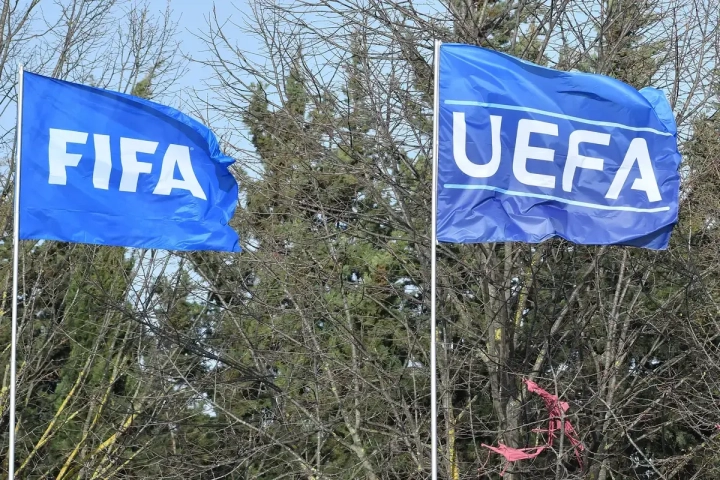
The most explosive week in the modern history of global football administration has reached a staggering climax. Early on Saturday morning, FIFA formally conceded defeat in its bitter, high-stakes civil war, officially abandoning the deeply controversial $20 billion plan to privatise the commercial rights of the World Cup. However, the governing body’s sudden capitulation has failed to quell the unprecedented rebellion. Emboldened by their absolute victory, UEFA, backed by a rapidly growing coalition of global federations, has immediately escalated the conflict by lodging a formal vote of no confidence against FIFA President Gianni Infantino.
The extraordinary developments over the past 24 hours signal a fatal collapse of Infantino’s authority. What began as a fiercely contested boardroom dispute over the creation of the ‘FIFA Forward Enterprise’ (FFE) has now transformed into an outright revolution aimed at permanently removing the 56-year-old from the pinnacle of the sport.
The Collapse of the FFE Empire
Infantino’s grand design unravelled with breathtaking speed. The FFE proposal, heavily championed by the FIFA president, sought to consolidate the global governing body’s commercial operations, including broadcasting, sponsorship, and ticketing for all future World Cups, into a newly formed subsidiary. FIFA intended to raise an estimated $4.2 billion by selling a minority stake of up to 30 per cent to a private equity consortium, reportedly led by Thrive Eternal.
The initiative was designed to inject unprecedented capital into the global game, promising massive infrastructure payouts to all 211 member associations. Yet, the scheme severely misjudged the cultural and institutional red lines of the sport’s traditional powerhouses.
When UEFA’s 55 member nations unanimously pledged to boycott all FIFA competitions earlier this week, the foundation of the deal began to fracture. The fatal blow, however, was delivered on Friday afternoon when the Confederation of North, Central America and Caribbean Association Football (CONCACAF) and the Argentine Football Association (AFA) publicly aligned themselves with the European mutiny.
Faced with the terrifying prospect of a World Cup devoid of its defending champions, the vast majority of its most marketable superstars, and the entirety of the European, North American, and reigning South American contingents, the commercial viability of the FFE project instantly evaporated. Financial sources close to the negotiations confirmed that the private equity backers, deeply spooked by the unified global boycott threat, rapidly withdrew their commitments late on Friday evening.
FIFA’s Midnight Surrender
With the investment capital vanishing and his political alliances entirely decimated, Infantino was forced into a humiliating retreat. Following an emergency, late-night session of the FIFA Council in Zurich, the governing body issued a succinct statement on Saturday morning confirming the total abandonment of the privatisation strategy.
“FIFA’s primary objective has always been, and remains, the unified growth and protection of global football,” the official press release stated. “While we maintain that exploring innovative commercial partnerships is vital for the long-term development of the sport in emerging regions, it is unequivocally clear that the FIFA Forward Enterprise proposal does not currently possess the necessary consensus among our member associations.”
The statement continued: “To preserve the integrity, harmony, and unity of the international football community, the FIFA Council has unanimously agreed to withdraw the FFE proposal in its entirety. The commercial rights and governance of the FIFA World Cup will remain fully and exclusively within the traditional framework of the organisation.”
UEFA Strikes the Jugular: The No-Confidence Motion
If Infantino believed that sacrificing his flagship commercial project would appease his detractors and secure his presidency, he severely underestimated the depth of the animosity emanating from Nyon. For UEFA, the mere attempt to sell off the soul of the World Cup behind closed doors represented an unforgivable breach of trust.
Rather than accepting the surrender and returning to the status quo, UEFA President Aleksander Čeferin immediately weaponised the momentum. On Saturday afternoon, European football’s governing body formally submitted a motion of no confidence against Infantino, a mechanism designed to trigger an extraordinary FIFA Congress and force a binding leadership vote long before the scheduled 2027 presidential elections.
A senior UEFA delegation released a blistering follow-up statement outlining the rationale behind the escalation. “The abandonment of the FFE proposal was an absolute necessity, but it does not erase the systemic failures of leadership that brought the sport to the brink of destruction,” the statement read.
“The attempt to covertly privatise the most sacred asset in global sport, combined with a persistent lack of transparency, repeated breaches of administrative due process, and the prioritisation of personal legacy over sporting integrity, has irrevocably shattered our confidence in the current FIFA administration. Global football requires leadership that respects its heritage and its stakeholders. Consequently, UEFA, with the full backing of its 55 member associations, has initiated formal proceedings to declare a vote of no confidence in President Gianni Infantino.”
Timeline of a Sporting Crisis (July–August 2026)
| Date | Event / Development |
| Mid-July | 2026 World Cup concludes; Infantino faces intense scrutiny over logistical failures and the controversial US disciplinary intervention. |
| Late July | The $20 billion FIFA Forward Enterprise (FFE) private equity proposal is leaked to the global press. |
| 30 July | UEFA unanimously agrees to boycott all FIFA competitions unless FFE is scrapped. |
| 31 July | CONCACAF and the Argentine Football Association (AFA) officially join the rebellion. |
| 1 August | FIFA formally abandons the FFE plan; UEFA immediately files a vote of no confidence against Infantino. |
The Mechanics of an Ousting
The initiation of a no-confidence motion plunges FIFA into uncharted constitutional waters. According to the organisation’s statutes, the FIFA Congress, comprising all 211 member associations, is the supreme legislative body capable of removing a sitting president.
To formally trigger an extraordinary Congress specifically for this purpose, UEFA must secure written backing from at least 20 per cent of the global membership (approximately 43 federations). Given that UEFA itself possesses 55 voting members, the threshold to force the assembly has already been comfortably surpassed.
The subsequent vote to officially remove the president would require a significant majority. Historically, Infantino has relied on a loyal voting bloc composed of smaller federations across Africa, Asia, and Oceania, maintained through the promise of increased central funding. However, the dynamics have shifted violently. With CONCACAF and influential South American nations now openly hostile, the arithmetic heavily favours the rebellion. Furthermore, without the $4.2 billion private equity injection to fund his expansive infrastructure promises, Infantino’s primary tool for securing the loyalty of developing nations has been completely neutralized.
The Legacy of the 2026 World Cup
The roots of this administrative coup extend well beyond the financial intricacies of the FFE proposal. Infantino’s presidency was already suffering from immense structural damage following the turbulent 2026 World Cup in North America.
The European establishment had not forgiven the FIFA president for the unprecedented political interference witnessed during the tournament. The shocking decision to bypass established judicial protocols and waive a red-card suspension for United States forward Folarin Balogun, following direct pressure from the American political establishment, infuriated traditional footballing nations. Coupled with widespread visa fiascos that denied entry to referees and international teams alike, the perception of Infantino as a weak leader prone to capitulating to external political and commercial pressures became firmly entrenched.
The End of an Era?
Gianni Infantino was elected in 2016 on a mandate to cleanse FIFA of the toxic, autocratic corruption that defined the era of his predecessor, Sepp Blatter. A decade later, he finds himself accused of the exact same administrative arrogance, operating with a blatant disregard for the collaborative governance required to run the world’s most popular sport.
As the weekend unfolds, intense lobbying is already underway. Delegations from UEFA and CONCACAF are reportedly establishing direct lines of communication with the Asian Football Confederation (AFC) and the Confederation of African Football (CAF) to secure the decisive votes required to formally end Infantino’s reign.
The abandonment of the $20 billion privatisation scheme represents a monumental victory for those seeking to protect the cultural heritage of the World Cup. Yet, the ensuing vote of no confidence guarantees that the war for the soul of the sport is far from over. Global football is preparing for a brutal, defining electoral battle, and the once-impregnable walls of the FIFA presidency are currently crumbling under the weight of a unified, global revolt.