Greenpeace UK campaigners have today announced they have created an underwater ‘boulder barrier’ in the UK’s most bottom-trawled offshore Marine Protected Area, which was set up to protect harbour porpoises. This comes as episode one of Blue Planet III aired on BBC One last night.
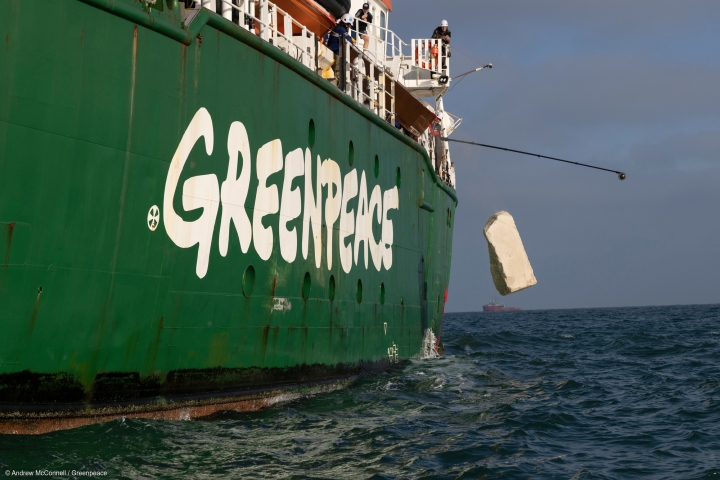
Over the weekend, activists placed the giant boulders, each weighing up to two tonnes, onto the seabed in the Southern North Sea off England’s east coast, forming an underwater barrier to prevent the destructive fishing method known as bottom trawling.
New analysis by Greenpeace UK shows that the Southern North Sea experienced at least 37,200 hours of bottom-towed fishing in 2025 – far more than any other UK offshore Marine Protected Area (MPA) last year.
Beyond destroying delicate seafloor habitats, bottom trawling can leave porpoises hungry by depleting key fish stocks while the intense noise pollution disrupts their ability to hunt[2]. The MPA in which Greenpeace placed their boulder barrier was specifically designated to protect the porpoise, supposedly to prevent “significant disturbance of this species” and ensure that the “availability of prey is maintained”. Despite this, it remains by far the most heavily-trawled offshore MPA in the UK.
Greenpeace UK’s ‘boulder barrier’ effectively closed 116 km² of the Southern North Sea MPA to bottom trawling. The campaign group declared the protected zone an ‘Ocean Park’, bringing the spirit of Britain’s cherished national parks to the open sea. Greenpeace will patrol the area aboard its ship the Arctic Sunrise to also deter other types of destructive industrial fishing over the coming days, including those with mid-water gear which impact the porpoise population.
Celebrities Simon Pegg and Benedict Cumberbatch, and MPs including Kerry McCarthy MP and Dr Roz Savage MP, have signed their names to the boulders marking their wish for UK offshore Marine Protected Areas to be properly protected.
Will McCallum, co-executive director of Greenpeace UK, said:
“Blue Planet III powerfully shows us the majesty of our ocean – as well as the very grave threats it faces. Imagine a bulldozer tearing through a treasured national park like Dartmoor or the Peak District. Out of sight, destruction on that scale is happening near our own shores in places we’re told are ‘Marine Protected Areas’. Hulking great ships prowl the sea day after day, stripping it of fish and killing precious wildlife like porpoises, sharks and sea birds.
“With our ship and a movement behind us, we’re doing what the government isn’t: protecting our seas. We announced in June that if the government didn’t act soon Greenpeace UK would take direct action. Nothing has happened since then. Now we’re setting a bold challenge to ministers: Ban destructive fishing across all our protected waters at home, and lead the charge for a network of global ocean sanctuaries right across the Atlantic.”
Kerry McCarthy MP, former Climate Minister and member of the All-Party Parliamentary Group for the Ocean, said:
“Industrialised fishing is having a hugely destructive impact on our marine environment, yet less than 1% of our seas are protected from it. They can legally tear through supposedly protected areas of the ocean, wreaking havoc upon the seabed, precious habitats and the sea life that lives there. Progress is too slow and nature can’t wait, which is why I’ve added my name to one of Greenpeace UK’s boulders. We need a ban on bottom trawling and properly protected ocean sanctuaries, both here in UK waters and right across the Atlantic Ocean.”
The Southern North Sea is an area of importance for harbour porpoises, supporting nearly 20% of the UK North Sea population. Despite its status as a Marine Protected Area, there are currently no restrictions on fishing activity in most of the MPA, meaning bottom trawlers, dredgers and other industrial fishing vessels threaten the porpoise population daily.
New analysis from Greenpeace shows that in 2025, bottom trawlers and dredgers churned up a cumulative 55,600 km² of seabed inside the UK’s Marine Protected Areas – an area 58 times the size of Dartmoor National Park. Trawlers and dredgers spent at least 115,000 hours towing gear along the seabed inside these MPAs in 2025 – the equivalent of more than 13 years of non-stop fishing.
The UK is signed up to a global target to protect 30% of land and sea for nature by 2030. A Greenpeace report revealed that nations are 265 years off reaching the ocean target[6], with only 3.5% of the world’s ocean currently fully or highly protected, and just 1% of UK waters.