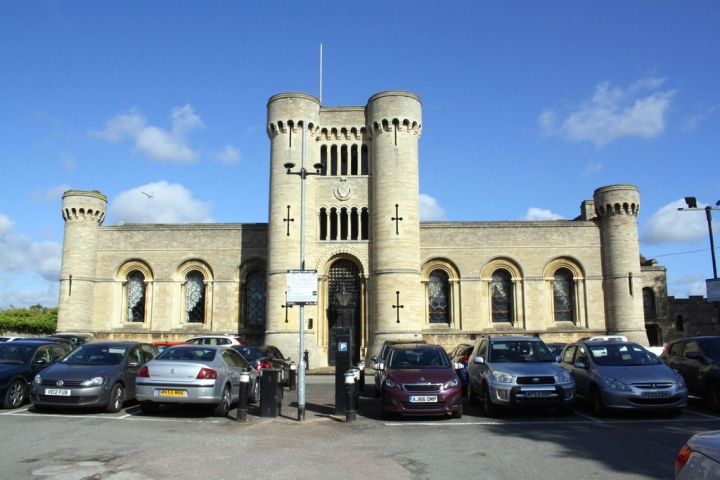
Plans to redevelop Peterborough’s historic Sessions House have been welcomed by the city’s Civic Society – according to Peterborough Today.
The Sessions House, currently vacant, was previously a bar and restaurant until 2012 and is now the subject of a planning application proposing partial demolition of a modern extension and internal alterations.
The building has a long history. The original custodial facility for the Soke of Peterborough was the Abbot’s Prison in Long Causeway, which had fallen into decay, leading to the indictment of the Marquess of Exeter in 1795 for neglect. The prison was rebuilt in the late 18th century but closed in the early 1840s after being deemed too small. A new facility on Thorpe Road was then designed by William Donthorne in the Norman style. Completed in 1842 at a cost of £8,000, it featured an octagonal outer wall, a rectangular central prison building, and a prominent entrance block facing Thorpe Road. The symmetrical frontage included a three-storey tower with a portcullis and mullioned windows, flanked by turrets with lancet windows and machicolations.
The entrance block incorporated a courtroom for the magistrates and became known as the Sessions House. Magistrates of the Soke of Peterborough, sitting as the court of quarter sessions, could try more serious cases, powers typically reserved for judges at assize courts. The Liberty of Peterborough Constabulary established its headquarters at the complex in 1857. The prison closed in 1878 after inmates were transferred to Cambridge or Northampton.
The police continued to use the old prison building until 1957, when a new station opened on Bridge Street and the old building was demolished. The Sessions House itself remained a courthouse until the expansion of court facilities led to the construction of a modern magistrates’ court in 1978 and the Peterborough Combined Court Centre in 1987. The Sessions House was later converted into a Mitchells & Butlers pub in the 1980s, then into a bar and restaurant in 2002, before closing and remaining unused since 2013.
“The demolitions described almost all relate to the mid-20th century rear extension and modern internal alterations of no historic value to the original building,” the Civic Society stated. “These sympathetic proposals for reactivated beneficial use of the Sessions House as a restaurant are welcomed and the Civic Society therefore supports this application.”
A heritage impact assessment submitted with the application includes photographs of the entrance hall, bar area, mezzanine floor, and the dining room, which features a hammerbeam roof. Heritage consultant Sam Falco said: “The overall condition of the interior is poor, with water ingress and deterioration owing to its long-term vacancy. The proposals do not seek to remove historic fabric from the interior of the building, with the proposals seeking repair and modest alterations largely by way of removing modern (late c20) split level platforms from previous restaurant uses and reconfiguration of modern WCs. The internal works to the historic core of the building are considered to result in a beneficial impact.”
The Peterborough Sessions House redevelopment seeks to preserve the building’s historic character while creating a functional modern restaurant, balancing heritage conservation with adaptive reuse.